
Buyer guidePublished 26 October 2026

Hard Drive Shredding for UK Businesses: When You Need It, and When Wiping Is Enough

Hard drive shredding is the image most people have of secure data destruction, and sometimes it is exactly the right answer. It is not always the best one. This guide explains what each method does, what the main standards say, and how to choose between wiping, degaussing and shredding for the drives your business is about to retire.

ISO 27001NIST 800-88WEEE CompliantCyber Essentials
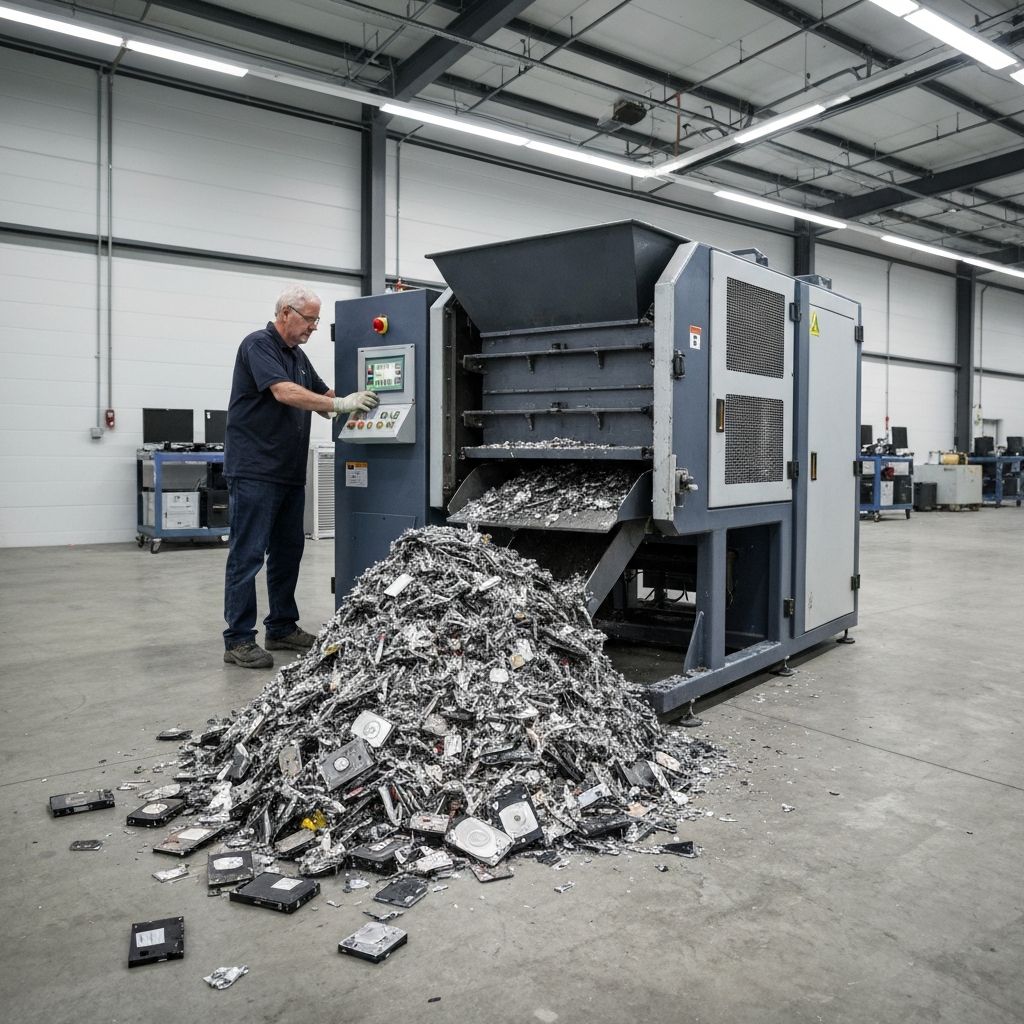
A worker beside an industrial shredder and a pile of shredded hard drives
Inside our UK facility
A worker beside an industrial shredder and a pile of shredded hard drives
The short answer

Do businesses need to shred hard drives?

Not always. The UK GDPR requires security appropriate to the risk, not a particular method. Certified erasure often suits working drives, while shredding suits failed drives, strict policies and some media. NIST 800-88 Rev 2 sets out three methods: clear, purge and destroy. Choose by data risk, then insist on per-device proof.

No law says you must shred

The ICO's guide to data security is clear that the UK GDPR does not define the security measures you should have in place. It requires a level of security that is appropriate to the risks. For retired drives, that means you pick a method that matches how sensitive the data was, and you can show why.

Nothing there says shredding is mandatory, and nothing says wiping is always enough. The decision belongs to you, which is why the evidence behind it matters. See whether you legally need a certificate of data destruction.

Wiping, degaussing and shredding in plain terms

  • Erasure (wiping) overwrites or cryptographically clears the drive so the device can be reused. It suits drives that still work.
  • Degaussing uses a strong magnetic field. It only works on magnetic media such as hard disks and tape.
  • Shredding physically breaks the drive into fragments. It works on drives that have failed and cannot be erased.

NIST SP 800-88 groups these into three methods: clear, purge and destroy. NIST is a US federal standard, not UK law, but UK providers and procurement teams use it widely.

What NIST 800-88 Rev 2 says

NIST published Revision 2 in September 2025. Several points affect how you choose a method:

  • Multi-pass overwriting is not needed for the clear method. NIST says this counters the obsolete DoD 5220.22-M language.
  • Degaussing should not be used on flash storage such as SSDs. A degaussing run can complete successfully while no sensitive data is sanitised.
  • Destructive techniques may be the only option when a drive has failed or is obsolete and clear or purge cannot be applied.
  • Pulverising and shredding should be avoided for anything but the lowest security categories of data, because as density and hardness of components increase, some destructive techniques can become ineffective.

That last point surprises many buyers, because shredding is often sold as the highest level of assurance. NIST's list of destroy techniques is disintegrate, incinerate, melt, pulverize and shred, and it warns that some of them become ineffective as the density and hardness of the media increase. Read our full breakdown in NIST 800-88 Rev 2: what it says about shredding, degaussing and multi-pass wipes.

A gloved hand loading a hard drive into a degausser

What the NCSC says

The NCSC's guidance on secure sanitisation and disposal of storage media is aimed at UK organisations. It says its methods protect against standard users with commercially available recovery tools or forensic services, and are proportionate for OFFICIAL data. They will not protect data from a skilled, well-funded laboratory.

  • For unencrypted media it describes overwriting the whole user-accessible space, and warns that remapped or bad sectors can leave data behind.
  • Degaussing is for magnetic media only, and you must check that the degausser is strong enough.
  • Physical destruction is to particles of 6mm or less, with the particle size verified afterwards.

The NCSC page was last reviewed in February 2025, before NIST published Revision 2, so expect it to change. Our reading is that the two do not conflict. They describe different adversaries and different data. Shredding to 6mm can be right for the second and insufficient for the first.

How to choose: a practical table

SituationUsually suitableWatch out for
Working laptops or servers you want to reuseCertified erasure with a certificate per deviceFactory resets and remote wipes are not erasure
Failed or damaged drives that will not erasePhysical destructionPartial damage can leave data readable
Magnetic tape and hard disksDegaussing, which the NCSC accepts for magnetic mediaCheck the degausser is strong enough. NIST does not treat degaussing as an approved destroy technique
SSDs and flash storagePurge or cryptographic erase where conditions are metNever degauss. Multi-pass overwriting adds little
Lowest-risk data, or a policy that requires shreddingShredding with verified particle sizeParticle size must suit the media
Highest-sensitivity dataAgree the method with your security lead against NISTDo not assume shredding is the strongest option

Cryptographic erase has conditions. NIST says it can only be used where no sensitive data has previously been stored in plaintext, and it should not be trusted where keys have been backed up or escrowed unless you are confident how they were managed. Switching encryption on for a drive that already holds data does not make it valid for that drive. That last sentence is our reading of the condition.

Onsite or offsite shredding

Once you have chosen destruction, the next question is where. Onsite shredding happens at your premises, so drives never leave your control in a readable state and your team can witness it. Offsite destruction happens at a secure facility after collection, which can suit sites where onsite access is not practical. Our decision guide compares them, and the onsite hard drive shredding service page explains how we run it.

What the paperwork should show

Whatever method you choose, the certificate is your evidence. It should record:

  • Each device, by serial number.
  • The method used, and the standard it was carried out to.
  • The date, and who carried it out.
  • For physical destruction, the particle size, ideally verified.

A single batch certificate that lists no serial numbers proves little. See how to verify a certificate of data destruction.

Need hard drives destroyed? Call 0800 677 1344 or email services@nanosoftltd.com. We cover Essex, London and the rest of the UK.

Common questions

Frequently asked questions

No. The ICO says the UK GDPR does not define the security measures you must use. It requires a level of security appropriate to the risks. Shredding is one way to meet that, certified erasure is another, and you should be able to explain your choice.

For many working drives, yes, if the erasure is done to a recognised standard and you receive a certificate for each device. It is not enough if the drive has failed and cannot be erased, or if your policy requires physical destruction.

No. NIST says degaussing should not be used on flash storage such as SSDs. A degaussing operation can complete successfully while no sensitive data is sanitised.

The NCSC describes destruction to particles of 6mm or less, with the size verified afterwards, for the risk levels its guidance covers. Higher-sensitivity data may need a different method, so agree it with your security lead.

A certificate listing each device by serial number, the method and standard used, the date and who carried it out. For physical destruction it should also record the particle size. Keep it with your waste transfer note.

Yes. We offer mobile, witnessed hard drive shredding at your site, and offsite destruction at our secure facility. See the onsite shredding service page or call us to discuss which suits your volume and risk.

Talk it through with a specialist

Reading is the easy half. Send us your asset list or your questions and we will map this guide onto your actual estate, with a same-day quote and no obligation.

ISO 27001NIST 800-88WEEE CompliantCyber Essentials