Do You Legally Need a Certificate of Data Destruction in the UK? Yes. Here Is Why.
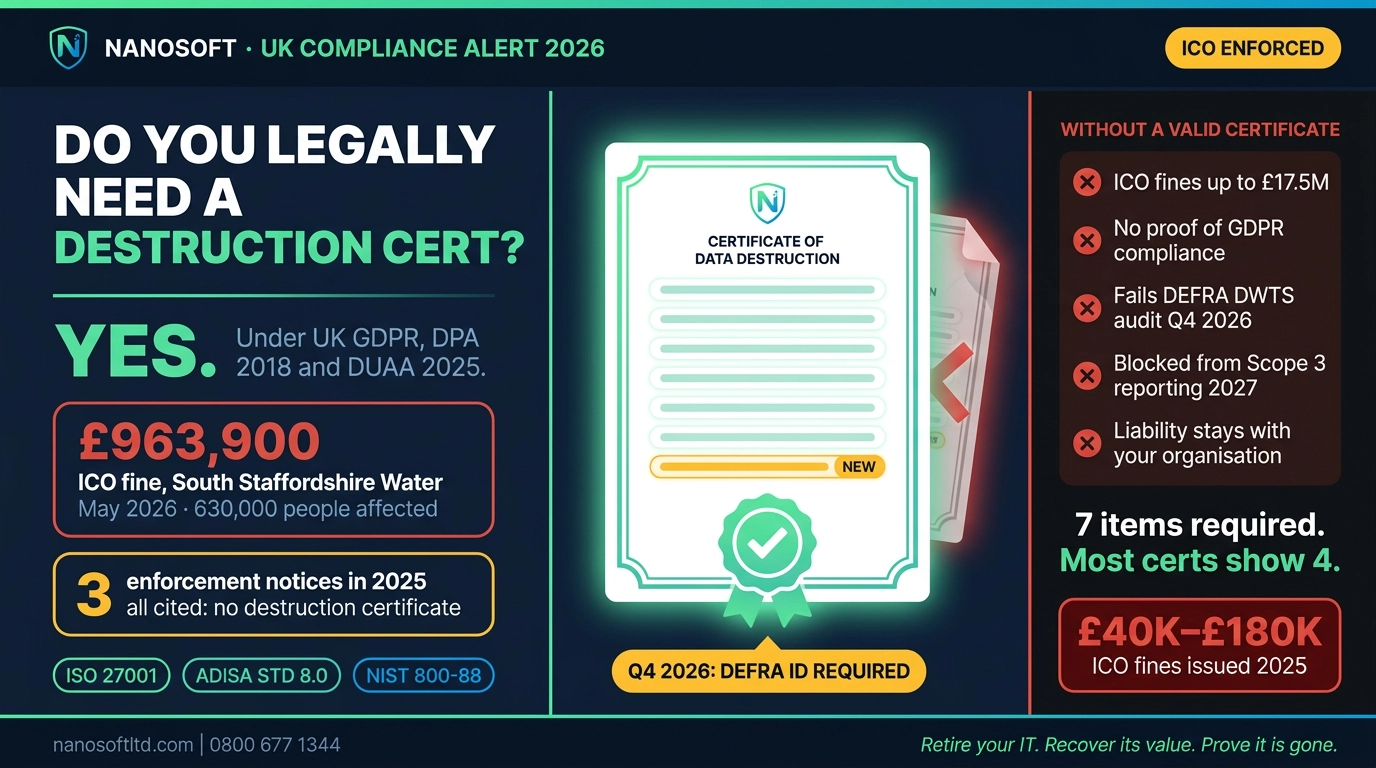
In 2025 the ICO issued three enforcement notices specifically against businesses whose disposed IT assets were found containing personal data. In every case the absence of a serial-numbered Certificate of Data Destruction was cited as evidence of inadequate technical measures under UK GDPR. These were not theoretical failures. They were real organisations, real fines between £40,000 and £180,000, and a clear signal that the ICO is treating end-of-life IT as an active enforcement priority.
The question of whether you need a certificate has a clear answer. Yes, under UK law, you do. The question most organisations have not yet asked is whether the certificate they currently receive from their ITAD vendor will still be valid from Q4 2026 onwards. The answer to that one is more complicated.
Key takeaways
A Certificate of Data Destruction is a legal requirement under UK GDPR Article 5(2), the Data Protection Act 2018 and the Data (Use and Access) Act 2025.
Three ICO enforcement notices in 2025 cited missing or inadequate destruction certificates as the primary evidence of non-compliance.
From Q4 2026 every certificate must reference a DEFRA Digital Consignment ID. Certificates without it will not satisfy regulatory auditors.
From 2027 UK Scope 3 Category 12 sustainability reporting requires destruction certificates to calculate and disclose end-of-life IT emissions.
The certificate must carry seven specific items to be considered valid under current and upcoming requirements.
The legal basis: three laws, one obligation
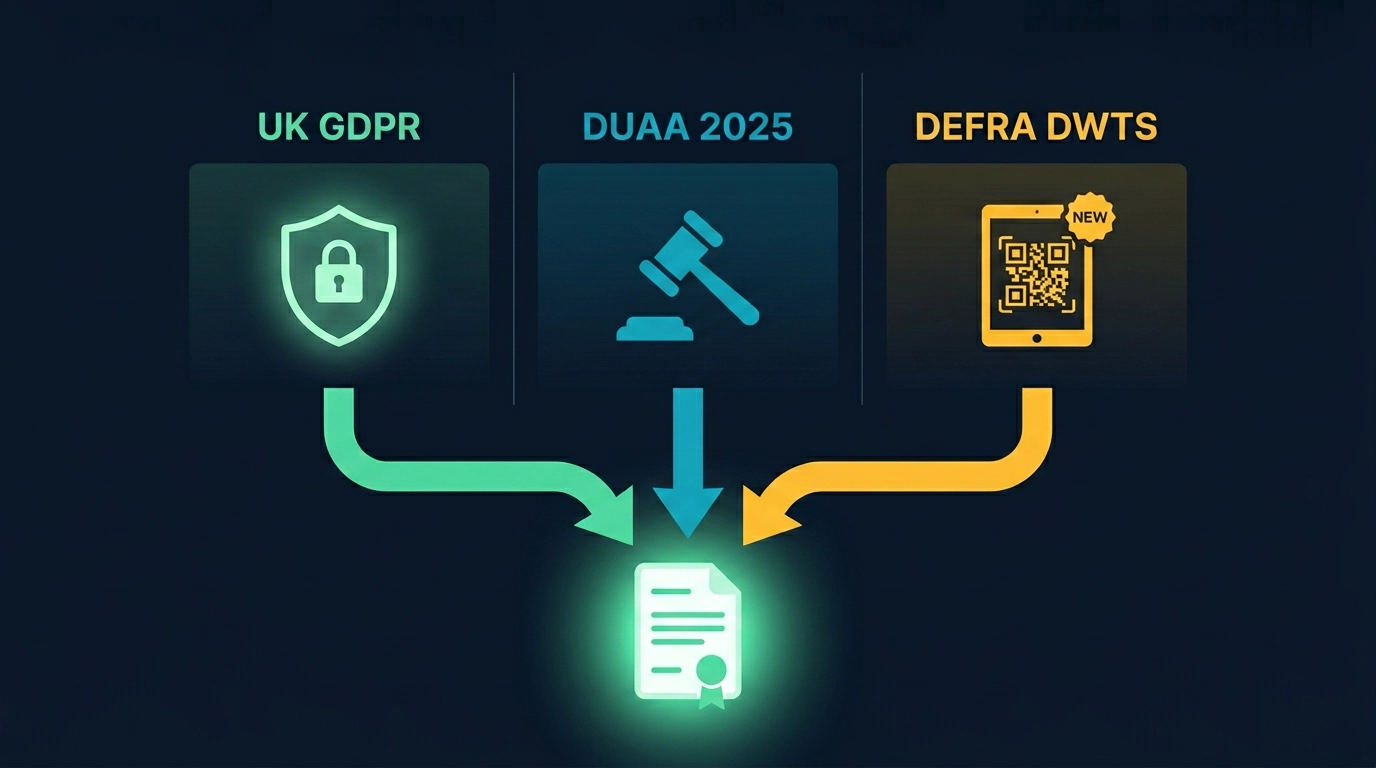
A Certificate of Data Destruction is not a voluntary best-practice document. It is the primary evidence a business can produce to demonstrate compliance with three overlapping legal obligations.
UK GDPR and the Data Protection Act 2018. Article 5(2), the accountability principle, requires data controllers to demonstrate that personal data has been handled appropriately throughout its entire lifecycle, including disposal. Article 32 requires appropriate technical and organisational measures to protect personal data. In the UK, obtaining a data destruction certificate is a legal requirement to ensure the full and permanent destruction of data. Without a certificate, a business cannot demonstrate compliance. It can only assert it. The ICO treats those two things very differently.
The Data (Use and Access) Act 2025. Receiving Royal Assent in June 2025, DUAA strengthens ICO enforcement powers and raises the bar on the standard of evidence organisations must produce during investigations. As of early 2026 the ICO's fining guidance is officially under review in light of the new law. The direction of travel is toward higher expectations, not lower.
DEFRA Digital Waste Tracking. From Q4 2026 all certificates must reference a digital consignment ID generated within the DEFRA system at the point of transfer, and certificates lacking this reference will not satisfy regulatory auditors from Q4 2026 onwards. This is a structural change to what constitutes a valid certificate, and most businesses currently receiving certificates from their ITAD vendors do not know it is coming.
What happened when businesses had no certificate
The enforcement picture in 2025 made the ICO's position clear. Three enforcement notices were issued to businesses whose IT assets were found containing personal data after disposal. Fines ranged from £40,000 to £180,000, and in each case the absence of a serial-numbered Certificate of Destruction was cited as evidence of inadequate technical measures under UK GDPR Article 32.
In May 2026 the ICO fined South Staffordshire Water £963,900 after a cyberattack exposed the personal data of more than 630,000 customers and employees. The regulator stated that proactive security is a legal requirement, not an optional extra, and urged organisations to review their controls, monitoring and legacy technology management. While that case concerned a network breach rather than IT disposal directly, the ICO's posture is identical: you must demonstrate appropriate measures, and documentation is the only way to do that.
The Q4 2026 change most businesses have missed
Here is the detail that almost nobody outside specialist ITAD circles is aware of yet. From Q4 2026, a Certificate of Data Destruction that does not include a DEFRA Digital Consignment ID is an incomplete document. It will not satisfy a regulatory auditor. Your ITAD vendor must be registered on DEFRA's Digital Waste Tracking Service, generate a digital consignment reference at the point of collection, and embed that reference in the certificate they issue you.
If your current vendor is not registered on DWTS, they cannot generate that ID. Which means every certificate they issue you from October 2026 is missing a mandatory field. You will not know this until an auditor flags it.
The practical implication is straightforward. Before October 2026, confirm your ITAD vendor is registered on DEFRA's Digital Waste Tracking Service and confirm in writing that their certificate template will include the DEFRA Digital Consignment ID from Q4 2026 onwards.
The 2027 requirement: sustainability reporting
A third deadline is building behind the first two. The UK Sustainability Reporting Standards will require large businesses to report Scope 3 Category 12 emissions from 2027, which includes end-of-life IT equipment disposal, and a properly issued destruction certificate from an accredited provider supplies the data chain needed to calculate and disclose those emissions accurately.
A certificate that carries full chain of custody information, methods used, weights and outcomes gives your sustainability team the data they need for Scope 3 disclosure. A generic or incomplete certificate gives them nothing. The same document that satisfies the ICO today needs to satisfy your sustainability auditor in 2027. That means the quality of the certificate matters now, not when the reporting deadline arrives.
Seven things your certificate must show
A valid Certificate of Data Destruction for a UK organisation in 2026 must carry all seven of the following. If any are missing, the document is incomplete for compliance purposes.
Company name and address of the disposing organisation.
Serial number of every data-bearing device, individually listed. Not a count, not a model summary. Serial numbers.
Data sanitisation method used, with the standard named explicitly. NIST SP 800-88 Rev. 2 at minimum.
Date of collection and date of destruction recorded separately.
ITAD vendor name and their certification numbers: ISO 27001 at minimum.
Chain of custody reference from your site to final outcome.
DEFRA Digital Consignment ID, mandatory from Q4 2026.
Ask your current ITAD vendor for their certificate template today. If items six or seven are absent, raise it before October.
What to do right now
Three actions, in order of urgency.
Confirm your ITAD vendor is DEFRA DWTS registered. Ask them directly. If they are not registered, their certificates will be non-compliant from October 2026 and you will need a new vendor before that date.
Request a sample certificate before your next disposal job. Check all seven items above are present. If the serial-number level tracking is missing, a count-level certificate is not sufficient evidence for the ICO.
Retain every certificate for at least five years. The ICO does not impose a mandatory retention period for destruction certificates specifically, but data protection records more broadly should be retained for a minimum of five years to cover the limitation period for regulatory action.
Retire your IT. Recover its value. Prove it is gone.
Every Nanosoft job produces a serial-level Certificate of Data Destruction covering all seven fields above, including the DEFRA Digital Consignment ID from Q4 2026. Combined with ISO 27001 certified processes and complete chain of custody documentation, every certificate we issue is built to satisfy the ICO, a sustainability auditor and a procurement due diligence review.
Contact Nanosoft: services@nanosoftltd.com | 0800 677 1344 | Unit 8 & 9 Maldon Trade Park, Heybridge, Maldon CM9 4LJ, UK
Nanosoft Team
Writer at Nanosoft - covering ITAD, data security, and sustainable technology lifecycle management.
Found this useful? Share it.