The Gold Mine in Your Server Room: The Hidden Economics of E-Waste
Somewhere in your organisation right now, there is probably a cupboard, a store room, or a corner of the server room holding retired laptops, old phones, and decommissioned network equipment. Most people who walk past it see clutter waiting to be dealt with. What they are actually looking at, if they knew the chemistry, is one of the richest ore deposits on the planet.
That is not a metaphor. It is a measurable, well-documented fact of materials science, and it is one of the strangest, most under-appreciated truths about the technology sitting in offices everywhere.
Key things you will understand after reading this
Why a tonne of old circuit boards contains far more gold than a tonne of gold ore.
The actual quantities of gold, silver, palladium and copper inside typical IT equipment.
Why global recovery rates for this value remain shockingly low.
What separates crude scrapping from genuine value recovery.
Why certified ITAD is where the real financial upside of IT disposal actually sits.
The number that should surprise you
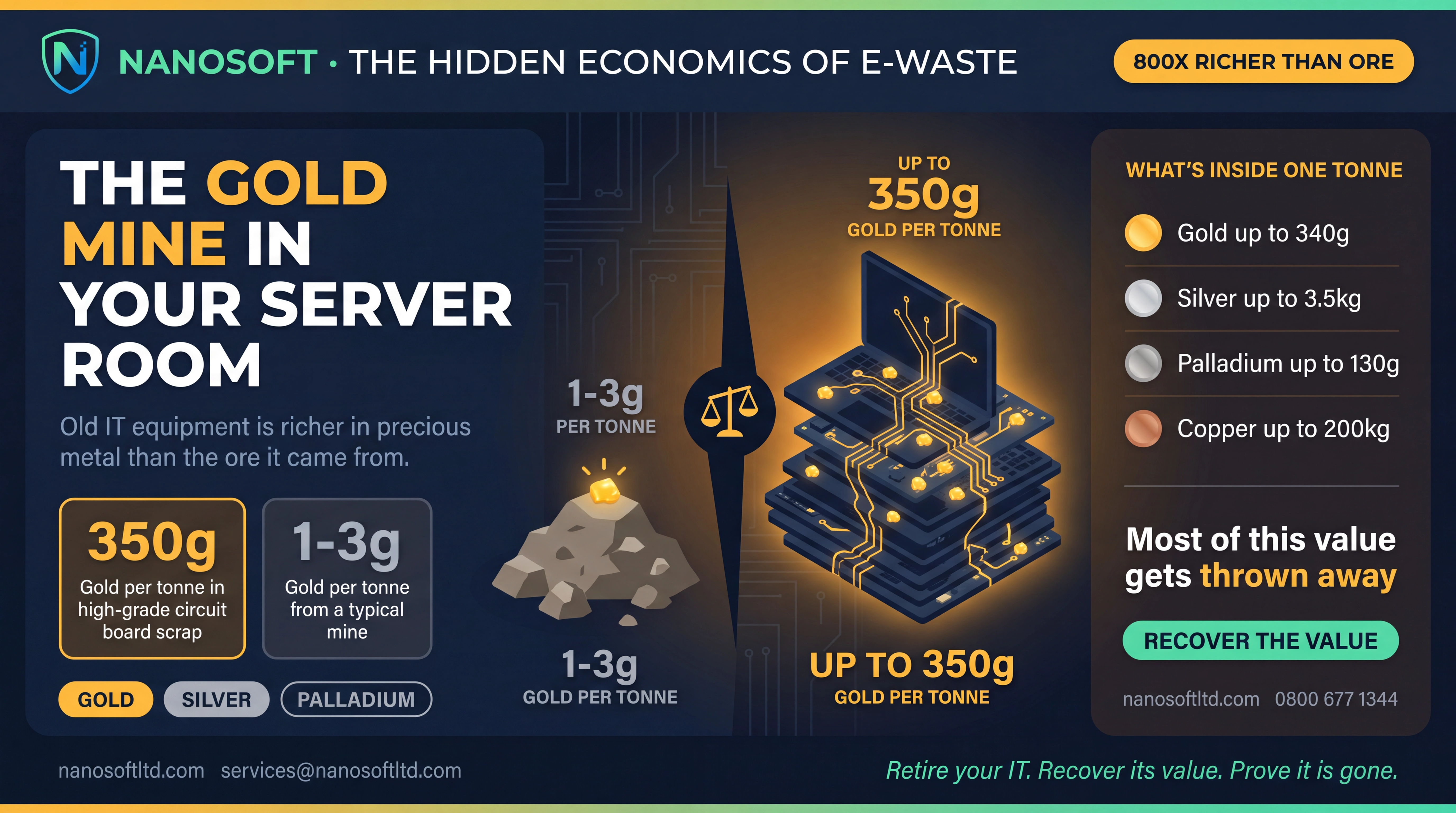
Start with the comparison that anchors everything else in this article. Traditional gold mines typically yield 1 to 3 grams of gold per tonne of ore. A commercial gold mine is considered a viable operation at those concentrations. Companies move mountains, literally, blasting and crushing enormous volumes of rock, to extract a few grams of gold per tonne processed.
High-grade electronic waste, by contrast, can contain 250 to 350 grams of gold per tonne. According to the United Nations, one metric tonne of e-waste from obsolete electronics can contain as much as 800 times more gold than an optimum tonne of mined ore. Read that again. The old laptops in your cupboard are not just electronic waste. By weight, they are a denser source of gold than the ore that gold mining companies spend billions of pounds extracting from the earth.
Why electronics are so metal-rich
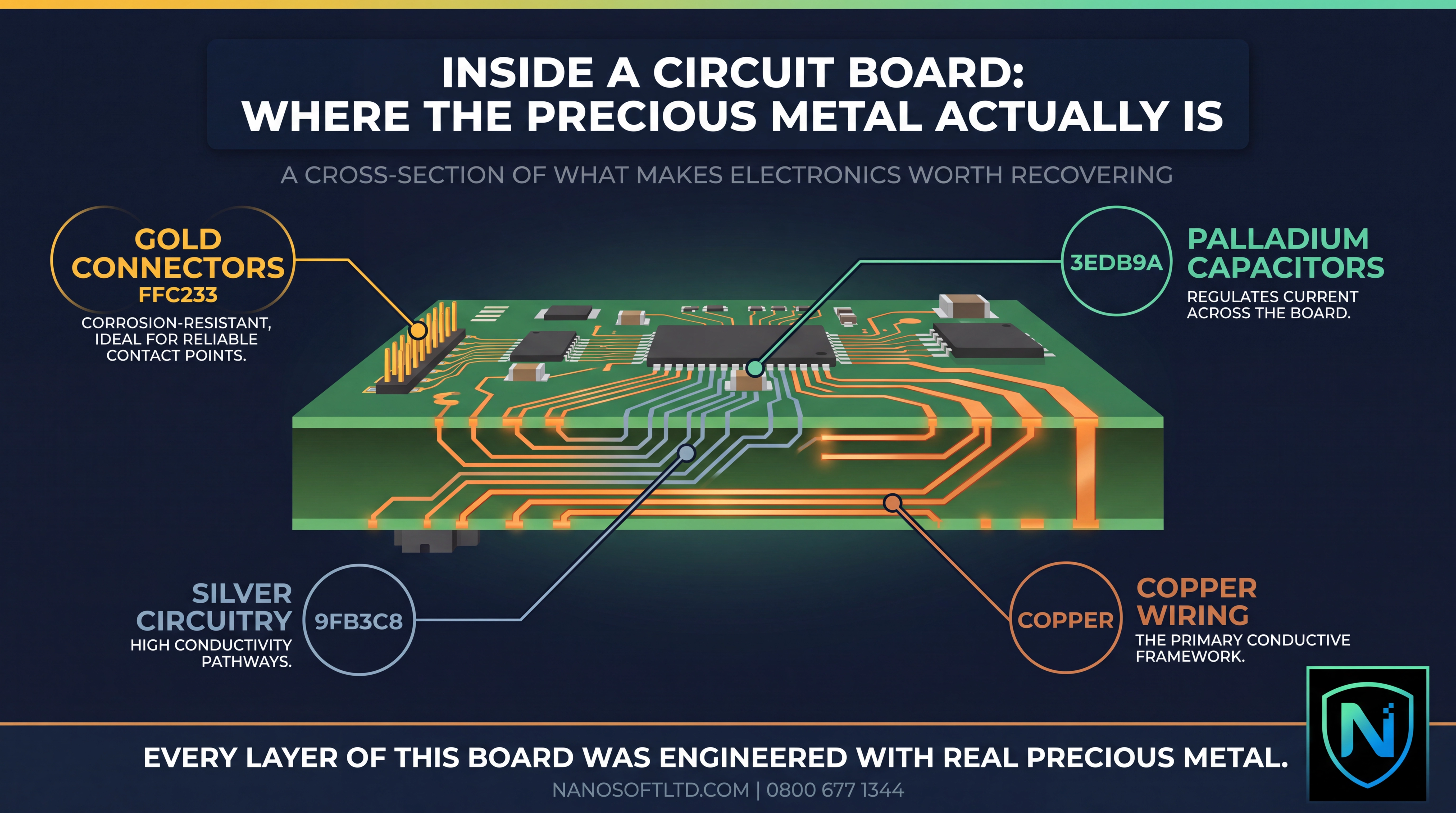
The reason comes down to what electronics are actually built from. A modern circuit board, the green fibreglass panel inside every laptop, phone, server and piece of network equipment, is not simply plastic and silicon. It is threaded with genuine precious metal, chosen specifically because of properties that plastic and cheaper metals cannot match.
Gold is used in connectors, pins and certain circuit pathways because it does not corrode and conducts electricity exceptionally well, which matters enormously at the microscopic scale of a modern processor or connector. Silver appears throughout circuitry for similar conductive reasons. Palladium is used in multilayer ceramic capacitors, the tiny components that regulate electrical current on nearly every board. Copper, present in far larger quantities, forms the wiring and connective pathways throughout every device.
One tonne of scrap mobile phones contains an average of 3.5 kilograms of silver, 340 grams of gold, 130 grams of palladium, and up to 130 kilograms of copper. Shredded printed circuit boards from computers often yield around 90 grams of gold and 400 grams of silver per tonne, with one tonne of printed circuit boards holding approximately 200 kilograms of copper as well. None of these figures are estimates or rounding. They are the product of decades of materials science research into exactly what is inside the devices that get thrown away every single day.
The scale of what the world is throwing away
The world generated 62 million tonnes of e-waste in 2022, and the metals locked inside that waste were worth an estimated 91 billion US dollars. That is not a projection or a theoretical maximum. It is the assessed value of gold, silver, copper, palladium and other recoverable metals sitting inside the phones, laptops, servers and appliances the world discarded in a single year.
And here is the part that should genuinely concern anyone who cares about either the environment or basic economic sense: despite this value, only around 20 to 25 percent of e-waste is properly recycled, with most ending up in informal or landfill operations where almost none of that value is recovered. The vast majority of that 91 billion dollars in recoverable material is currently being buried, burned, or shipped to informal processing operations that recover a fraction of what proper refining could capture.
Why so little of this value gets recovered
The gap between what is theoretically recoverable and what actually gets recovered comes down to three structural problems, all of which sit squarely within the ITAD industry's ability to fix.
Most e-waste never enters a formal recycling system at all. A device that ends up in a general bin, a skip, or an informal export chain to a developing country never reaches a facility capable of proper metal extraction. The precious metal content simply gets lost, buried in landfill or crudely burned to strip lower-value materials, destroying most of the recoverable value in the process.
Crude scrapping is not the same as refining. Even within formal recycling channels, there is a significant difference between an operator who dismantles devices for basic scrap value and a certified facility that applies proper metallurgical extraction. Precious metal recovery at scale requires specific chemical and thermal processes to separate gold, silver and palladium from circuit boards efficiently. Cutting corners at this stage means throwing away most of the value even when the device technically gets "recycled."
Businesses have historically treated old IT as pure cost, not as an asset with recoverable value. When an organisation's only question when disposing of IT equipment is "who will take this away most cheaply," the answer is frequently an operator who has calculated that the best way to offer a low price is to extract value quickly and crudely, passing none of it back to the client who owned the equipment.
What genuine value recovery actually looks like
A certified ITAD process treats retired equipment the way the economics actually justify: as a resource with real, calculable value, not simply as waste requiring disposal. This means working devices are assessed for refurbishment and resale, which captures far more value than melting a functioning laptop down for parts. Devices beyond economic repair go through proper data destruction first, and then enter certified recycling channels where precious metal content is genuinely extracted rather than crudely stripped and discarded.
The commercial implication for any organisation retiring IT equipment is straightforward. A disposal process built around genuine value recovery, rather than the cheapest possible collection quote, can return meaningful money against the cost of certified data destruction. The gold, silver, palladium and copper in a batch of retired servers and laptops is real, quantifiable value. Whether your organisation ever sees any of it back depends entirely on which kind of disposal process those devices go through.
The bigger picture
Beyond the immediate financial case, the environmental logic is just as compelling. Every gram of gold recovered from a circuit board is a gram that does not need to be freshly mined, with all the land disruption, water use and carbon emissions that primary mining involves. Urban mining, extracting metal from products that already exist rather than digging fresh ore from the ground, is measurably less environmentally destructive per gram of metal recovered. The old laptops sitting in a cupboard are not just a source of financial value. Properly recovered, they are also one of the more genuinely sustainable sources of precious metal available anywhere in the modern economy.
Retire your IT. Recover its value. Prove it is gone.
Nanosoft applies genuine value recovery to every disposal job, assessing devices for refurbishment and resale before anything proceeds to certified recycling, with precious metal content properly captured rather than crudely discarded. Combined with NIST SP 800-88 Rev. 2 certified data destruction and full documentation, we make sure the value in your retired IT equipment comes back to you, not to whoever handled it after it left your building.
Contact Nanosoft: services@nanosoftltd.com | 0800 677 1344 | Unit 8 & 9 Maldon Trade Park, Heybridge, Maldon CM9 4LJ, UK
Nanosoft Team
Writer at Nanosoft - covering ITAD, data security, and sustainable technology lifecycle management.
Found this useful? Share it.