
Many businesses moved their backups to disk or the cloud years ago and kept the old tapes "just in case". Those tapes are still sitting in a cupboard, a safe or an offsite store, full of customer, staff and financial records from a decade ago. Under UK GDPR they are still personal data, and destroying them properly is harder than most people assume.
This piece covers why old tapes are a compliance problem, not just a storage one, why degaussing them may not do what you expect, and what a defensible clear-out looks like.
Why old tapes are still your problem
The ICO's guidance on storage limitation starts plainly: "You must not keep personal data for longer than you need it." It adds that you "should also periodically review the data you hold, and erase or anonymise it when you no longer need it."
Backups are not exempt. In its guidance on the right to erasure, the ICO says that when a valid request arrives "you will have to take steps to ensure erasure from backup systems as well as live systems."
The ICO is realistic about live backups. It accepts that data may stay in a backup until it is overwritten, as long as you put it "beyond use" and the backup is "simply held on your systems until it is replaced in line with an established schedule."
That last phrase is the problem with the cupboard. A tape that was taken out of rotation years ago is not going to be replaced on any schedule. Our reading: the ICO's reassurance describes a working backup cycle, not an archive nobody has looked at since the last office move.
Why degaussing may not do what you think
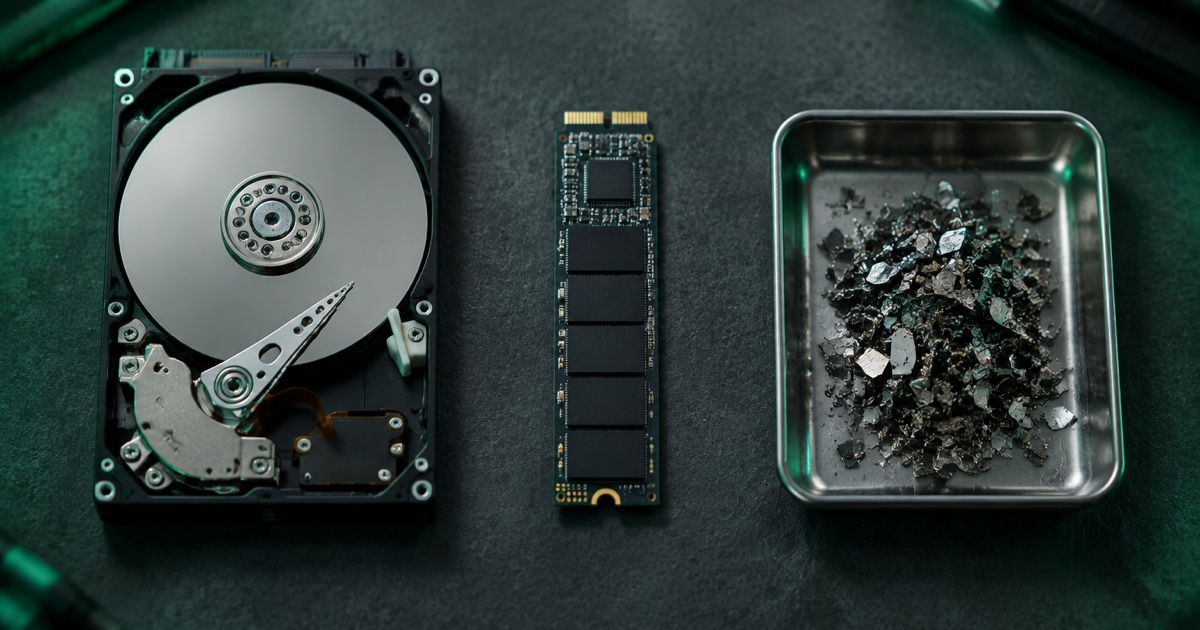
Degaussing, wiping magnetic media with a strong magnetic field, has long been the standard answer for tapes. NIST SP 800-88 Revision 2, published in September 2025, is now much more cautious.
NIST explains that newer magnetic media use higher coercivity, meaning they need a stronger field to erase, and that "many existing degaussers do not have sufficient force to effectively degauss such ISM." It says degaussing only purges data when "the strength of the degausser is carefully matched to the ISM coercivity."
Then comes the warning that matters most for tapes:
degaussing can damage (i.e., make unusable) some types of ISM, potentially rendering them inoperable (e.g., if the servo tracks are damaged), but fail to sanitize the target data.
Modern data cartridges rely on factory-written servo tracks to guide the drive. IBM's cartridge guidance is blunt: "Do not degauss a cartridge tape." It explains that degaussing erases the servo tracks and leaves the cartridge unusable.
Put those together and you get an awkward result. After degaussing, a tape that will no longer load in a drive proves the servo tracks are gone. It does not prove the data is. NIST also notes that, at the time of writing, degaussing "is not considered an approved destroy sanitization technique."
The two routes that work
Overwrite tapes you want to reuse. If the tapes still have a life, the drive itself can erase them. IBM describes a host-run Data Security Erase that "physically overwrites the data on the tape without damaging the servo tracks." It is slow, but it leaves a usable cartridge and a clear record.
Destroy tapes you do not. For tapes that are simply being retired, physical destruction by a specialist is the cleaner answer. If you do degauss as well, treat it as an extra step, not as the proof.
If the tapes were written with encryption and the keys were managed properly, destroying every copy of the keys may also count as cryptographic erase. NIST's usual condition applies: it only works if the data was never written to the tape unencrypted.
A defensible clear-out
- Find them all. Check offices, safes, the comms room and any offsite storage contract. Offsite tape vaulting agreements often outlive the people who signed them.
- List them by barcode. Each cartridge usually carries a volume label. Record every one before anything leaves the building.
- Decide what must be kept. Check your retention schedule. If legal, tax or contractual rules require some records to be kept, confirm you can still read those tapes, or migrate the data first.
- Choose the route per tape. Overwrite for reuse, destroy for retirement. Do not rely on degaussing alone.
- Get evidence per cartridge. A certificate that lists each tape by its barcode, the method used and the date, not a weight or a box count.
- Fix the cause. Add tape and other backup media to your retention schedule so the cupboard does not refill.
Our ITAD documentation checklist covers the paperwork, and our piece on what NIST 800-88 Rev. 2 actually says goes further into degaussing and the other methods.
The honest summary
Old backup tapes feel like history, but the people in those records still have rights, and the ICO expects backups to be on a schedule, not in a cupboard. Find the tapes, list them, keep only what you must, and destroy the rest with evidence per cartridge. A tape that will not load after degaussing is not a certificate.
Nanosoft Team
Writer at Nanosoft - covering ITAD, data security, and sustainable technology lifecycle management.
Found this useful? Share it.