Where Does Your Old IT Equipment Actually End Up? The UK Illegal E-Waste Problem Explained
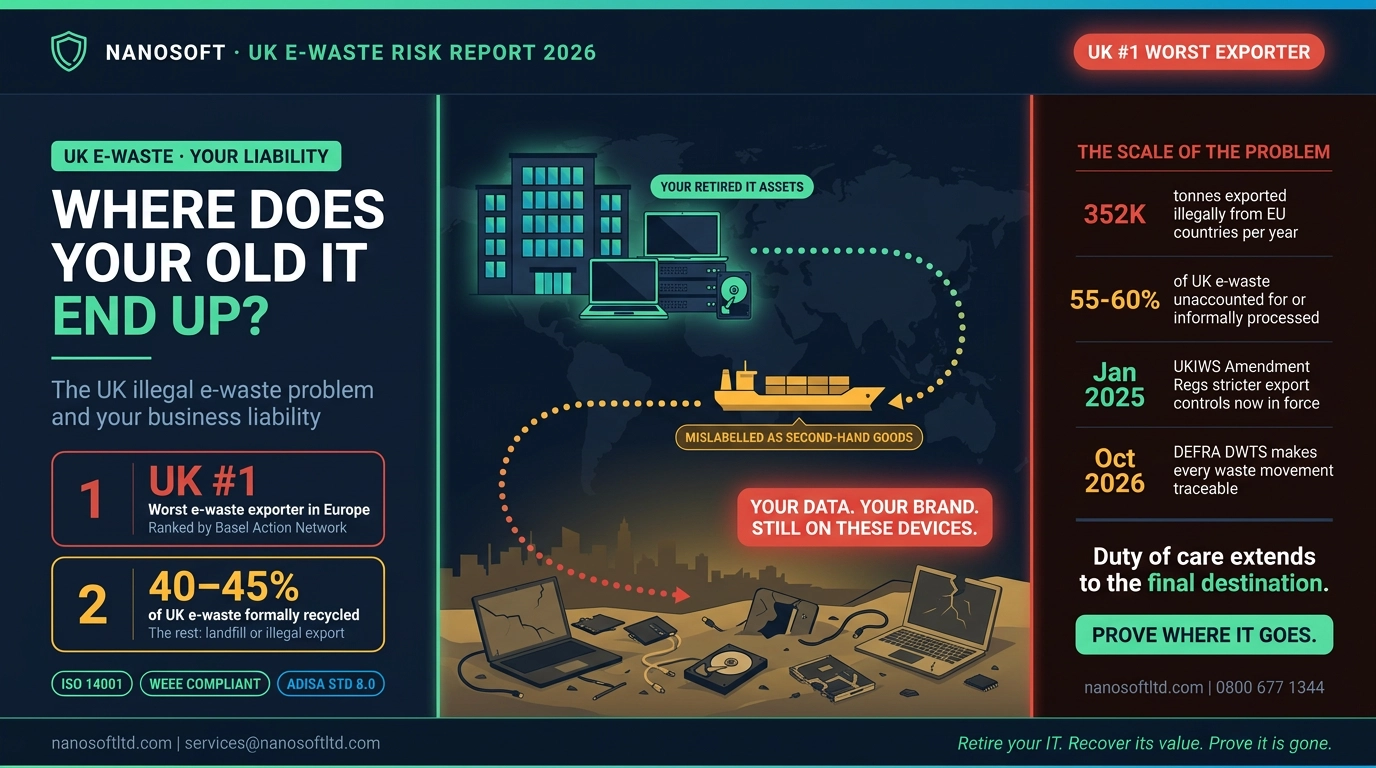
The Basel Action Network ranked the UK as the worst e-waste exporter in Europe. Interpol, Greenpeace and the Environmental Investigation Agency have all documented the same pattern: UK businesses hand their old IT to the cheapest disposal company available, and that equipment ends up on a cargo ship to West Africa or South Asia, mislabelled as second-hand goods, with the original data still on the drives.
Most businesses never know this happened. The van came. The kit went. Someone signed a piece of paper. Box ticked.
But your duty of care as the waste generator does not end at your loading bay. Under UK environmental law, the chain of responsibility for what happens to your discarded equipment extends to its final destination. If that destination is an informal dump in Lagos or Accra, your certification gap is part of how it got there.
Key takeaways
The UK was ranked Europe's worst illegal e-waste exporter by the Basel Action Network.
Only 40 to 45 percent of UK e-waste is formally recycled. The rest ends up in landfill or illegal export.
The UK International Waste Shipments Amendment Regulations 2024 came into force January 2025, tightening export controls significantly.
Your business duty of care extends to the final destination of your disposed IT assets.
DEFRA Digital Waste Tracking from October 2026 makes every waste movement traceable, ending the opacity that illegal operators rely on.
The scale of the problem
The UK has historically been one of the world's largest exporters of e-waste, with numerous documented cases of illegal transboundary shipments to developing countries in West Africa and South Asia, and investigations by Interpol, Greenpeace and the Basel Action Network have exposed the UK's role in violating international e-waste trade regulations.
Despite a ban on e-waste exports to developing countries, 1.3 million tonnes of undocumented goods are exported from the EU each year, and the UK was ranked as the worst offender in Europe by the Basel Action Network. The Basel Action Network's methodology involved placing GPS trackers on electronic devices deposited at recycling facilities across Europe. Devices deposited at UK facilities were subsequently tracked to Nigeria, Ghana, Pakistan, Tanzania and Thailand.
Only around 40 to 45 percent of UK e-waste is formally recycled. The rest often ends up in landfill or is exported illegally. For a country generating millions of tonnes of electronic waste annually, that is an enormous volume of equipment leaving the formal compliance chain entirely.
How businesses end up contributing without knowing it
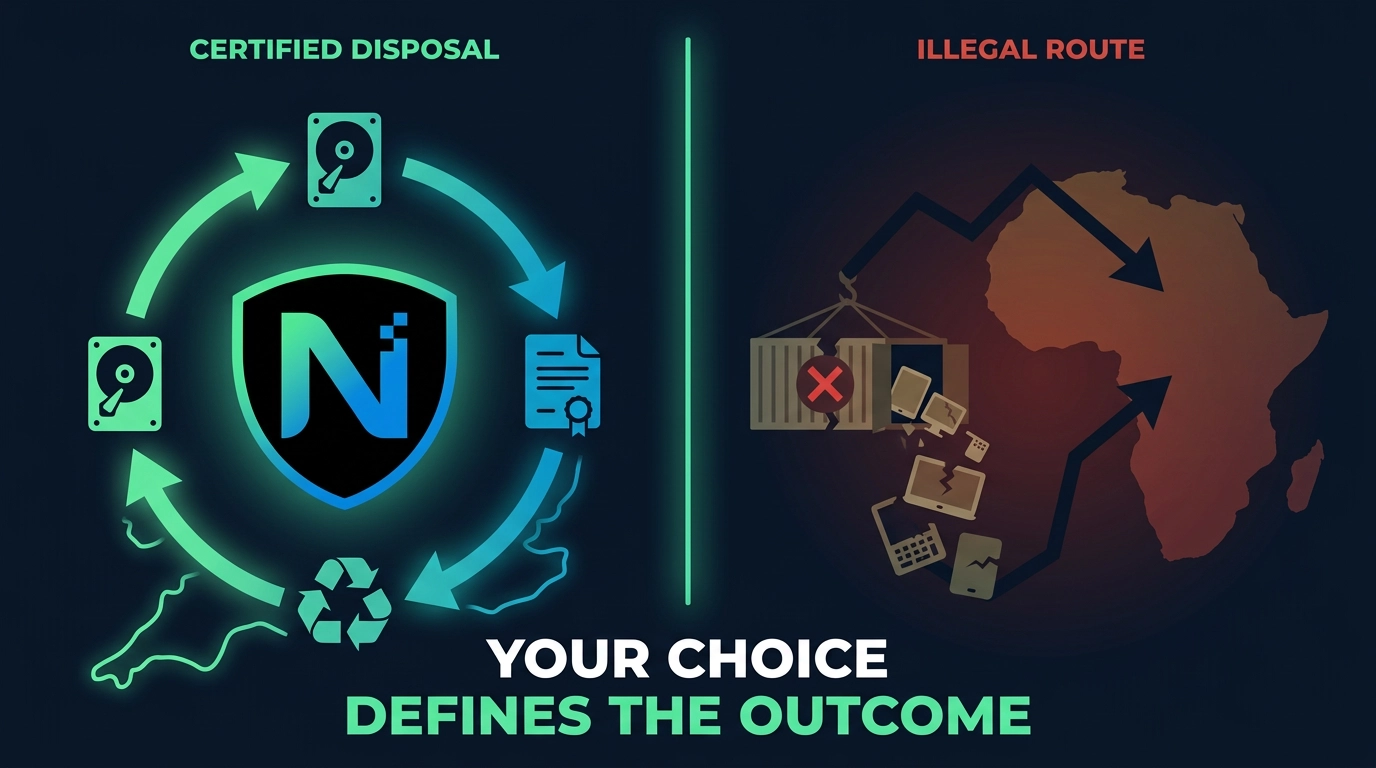
The route from a UK office to a dump site in West Africa typically follows the same pattern. A business retires a batch of IT equipment. They accept a quote from an operator with a van, a website and a low price. No certifications are checked. No downstream transparency is requested. The equipment leaves the building on a Waste Transfer Note.
Stricter regulations raise the risk of illegal exports, waste dumping and fraudulent waste reporting, and internal auditors should monitor for red flags such as incomplete documentation, misdeclared waste or export routes involving high-risk jurisdictions. The mechanism operators use to bypass controls is straightforward: equipment is mislabelled as working second-hand goods for resale rather than waste for disposal, which allows it to bypass the Waste Electrical and Electronic Equipment Regulations entirely. Once it arrives in the destination country and is found to be non-functional, it is handed to informal workers for component recovery using open burning and acid baths, processes that release lead, mercury, cadmium and brominated flame retardants into soil and groundwater.
Your company name and data may still be on the device when this happens.
The regulatory tightening in 2025 and 2026
The legal framework governing e-waste export has tightened significantly in the past 18 months and will tighten further.
The UK International Waste Shipments Amendment Regulations 2024 came into force on 1 January 2025, introducing stricter controls on the import and export of WEEE. This legislation increases the obligations on businesses to verify that their waste disposal routes are compliant and that the receiving facilities in destination countries meet equivalent environmental standards to UK operations.
The government's March 2026 Waste Crime Action Plan introduced proposals including potential penalty points on driving licences for fly-tipping offences, conditional cautions involving unpaid work, and approaches to publicly naming offenders. The direction of enforcement is toward personal accountability, not just corporate fines.
From October 2026, a mandatory digital waste tracking system becomes compulsory for receiving waste sites, aiming to improve transparency and detect illegal activity. Every movement of controlled waste will require a digital record on DEFRA's platform. The paper trail that allowed illegal operators to function with near-impunity is being replaced by a central government database that regulators can search in real time.
Your liability as the waste generator
Under the Environmental Protection Act 1990 duty of care provisions and the WEEE Regulations 2013, you are responsible for ensuring your waste is handled appropriately by whoever you pass it to. The Environment Agency now possesses the authority to impose unlimited financial penalties for environmental offences, and business leaders must recognise that compliance is no longer optional.
If your equipment is found at an illegal dump, the chain of documentation is audited backwards. A Waste Transfer Note naming your company as the source of the waste establishes your role in the chain. If you cannot demonstrate due diligence in vendor selection, the enforcement exposure is yours.
The data liability sits alongside the environmental one. Devices at informal dumps in West Africa still contain recoverable data. Your client records, employee files and financial documents are accessible to anyone who connects the drive to a basic laptop, which is standard practice at informal recycling sites. The ICO has jurisdiction over that data, regardless of where in the world the device ends up.
What responsible IT disposal actually looks like
The answer is not to stop disposing of IT equipment. It is to dispose of it through a certified chain that can prove exactly where it goes.
A compliant ITAD partner provides downstream transparency as a standard deliverable, not an optional extra. That means documentation of where reusable equipment is resold through responsible channels in the UK, and where non-reusable material is recycled through licensed Approved Authorised Treatment Facilities. No illegal export routes. No paper notes that can be falsified. And from October 2026, a DEFRA Digital Waste Tracking consignment reference on every Certificate of Destruction.
The environmental and data compliance cases are the same decision. A certified, ISO 14001 accredited ITAD vendor operating under certified data destruction standards applies data destruction and environmental accountability simultaneously. The chain of custody that satisfies the ICO on data is the same chain of custody that satisfies the Environment Agency on waste.
The ESG dimension: Scope 3 from 2027
For larger organisations, the accountability extends into sustainability reporting. From 2027, UK Sustainability Reporting Standards require large businesses to report Scope 3 Category 12 emissions, which includes end-of-life IT equipment disposal. A certified disposal chain with documented outcomes gives your sustainability team the data they need. An uncertified disposal route gives them nothing, and may expose emissions that should have been avoided through responsible refurbishment and recycling.
This is a board-level issue, not just an IT department one. The organisations building responsible disposal into their procurement criteria now are the ones whose sustainability reports will be defensible in 2027.
Retire your IT. Recover its value. Prove it is gone.
Nanosoft provides fully certified, fully transparent IT asset disposition for UK and EU organisations. Every job is completed through a documented, auditable chain with ISO 14001 certified environmental management, WEEE-compliant recycling through licensed AATFs, zero illegal export, and complete downstream transparency. Where assets carry reusable value, they are refurbished and resold in the UK through theNanoOutlet.com, keeping value and equipment in the formal economy.
Contact Nanosoft: services@nanosoftltd.com | 0800 677 1344 | Unit 8 & 9 Maldon Trade Park, Heybridge, Maldon CM9 4LJ, UK
Nanosoft Team
Writer at Nanosoft - covering ITAD, data security, and sustainable technology lifecycle management.
Found this useful? Share it.