UK Cyber Resilience Pledge and Cyber Shield: What the Government's July 7 Announcements Mean for Your Business
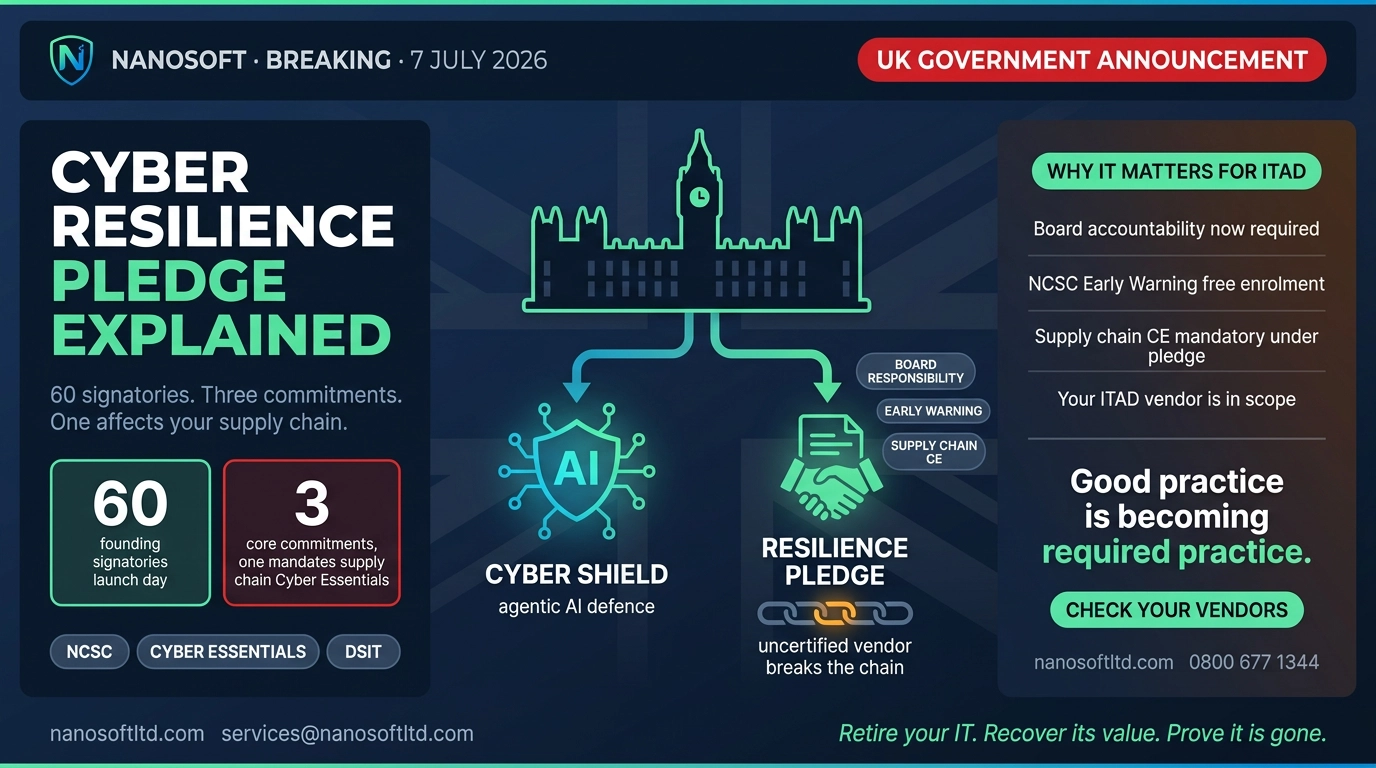
On 7 July 2026, the UK government made two significant cybersecurity announcements on the same day. The NCSC unveiled Cyber Shield, a national agentic AI defence initiative. Separately, the Secretary of State for Science, Innovation and Technology, Liz Kendall, launched the Cyber Resilience Pledge with 60 founding signatories. One is a long-term technical vision. The other has an immediate, practical implication for how you manage every vendor in your supply chain, including the one that disposes of your IT equipment.
Two announcements on the same day demonstrate the government's determination to improve the level of cybersecurity within the UK. Read together, they signal the direction UK cybersecurity policy is heading for the rest of the decade: toward board-level accountability, verified supply chain security, and government-coordinated defence at a scale no individual organisation could build alone.
Key takeaways
Cyber Shield is NCSC's national agentic AI cyber defence programme, built around six core capabilities including vulnerability discovery and national-level mitigation.
The Cyber Resilience Pledge launched the same day with 60 founding signatories and three core commitments.
Commitment three requires organisations to implement Cyber Essentials across their entire supply chain, which includes ITAD and IT disposal vendors.
Experts describe the Pledge as "the soft edge of a hardening policy position" that will likely become mandatory through future regulation.
The Pledge arrives alongside the Cyber Security and Resilience Bill, currently progressing through Parliament.
What Cyber Shield actually is
At the first annual lecture at Bletchley Park in May 2026, the Director of GCHQ, Anne Keast-Butler, set out the ambition: to reimagine cybersecurity in the AI world, developing a blueprint for a new national cyber defence capability that hardwires cutting-edge agentic AI into machine-speed cyber defence. On 7 July, the NCSC put substance behind that ambition, calling for collaboration from academia, critical national infrastructure organisations, frontier AI labs and the cyber defence sector to build a national-scale, collaborative approach to agentic cyber defence, using frontier AI to identify, reduce and resolve national cyber risk.
The reasoning behind Cyber Shield is straightforward: attackers already use AI to discover vulnerabilities in minutes rather than weeks, and defenders cannot patch at that speed using current methods. Cyber Shield is built around six core capabilities: reliable and explainable AI for cybersecurity, federated agents, vulnerability discovery and mitigation, coordinated detection and response, national-level scanning, and national-level mitigation.
Security commentators were quick to point out the gap between this ambitious vision and where most organisations currently stand. A lot of what compromises organisations is not a technical flaw an AI agent would flag; it is a process or configuration failure, with the fundamentals of asset management, robust access control, patching and monitoring being where the focus should sit. Most organisations that underpin national resilience are still constrained by legacy infrastructure, patching timelines and varying levels of AI maturity, meaning cyber defence will not operate at true machine speed in practice unless those fundamentals are addressed. Cyber Shield is a solution for tomorrow's threats. It does not replace the discipline UK organisations need today.
What the Cyber Resilience Pledge actually requires
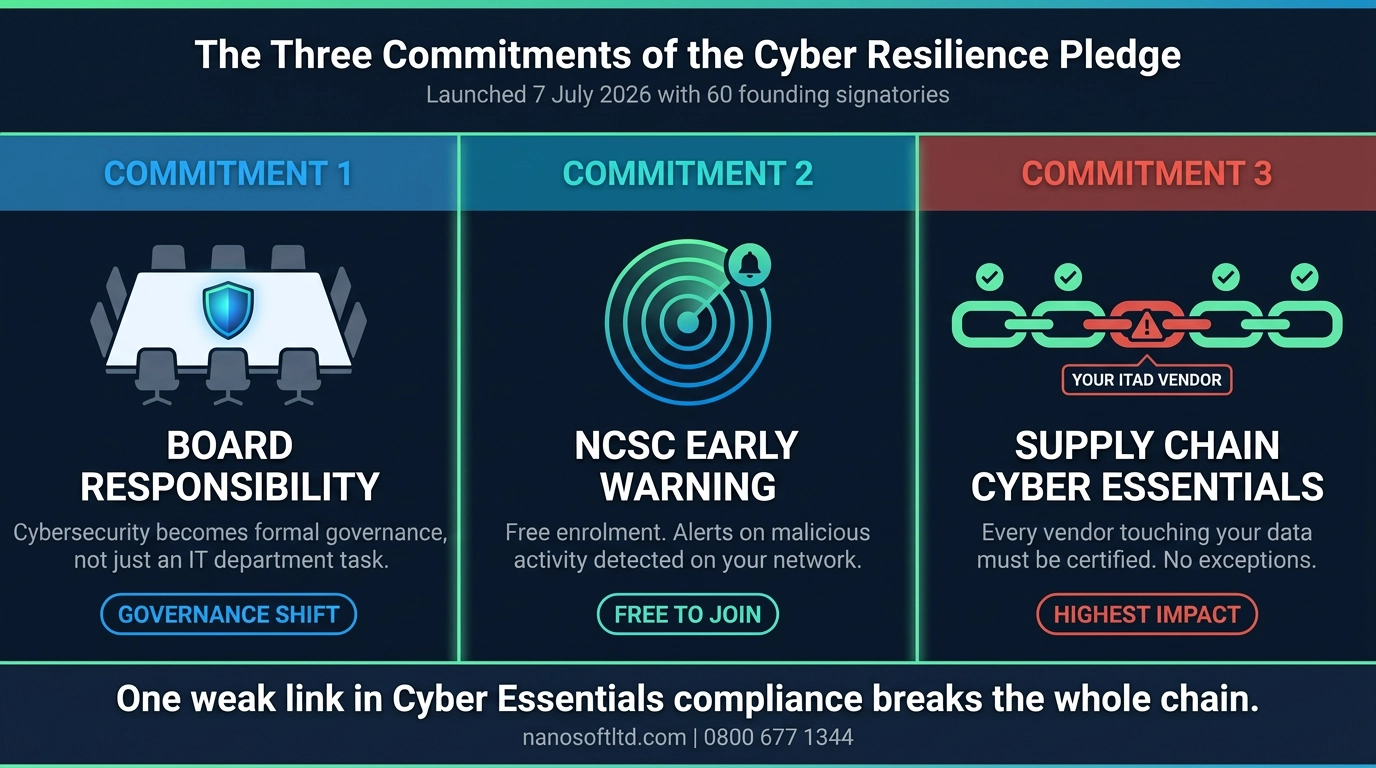
The Cyber Resilience Pledge is the announcement with an immediate, practical impact on how UK businesses manage their vendor relationships. The three core commitments of the pledge are to make cybersecurity a board responsibility, to enrol in the NCSC's Early Warning service, and to implement Cyber Essentials across the supply chain.
Commitment one: board responsibility. Cybersecurity moves from being an IT department concern to a formal governance responsibility sitting with the board. This mirrors the direction of the Cyber Security and Resilience Bill, currently progressing through Parliament, which sets out a major overhaul of the UK regulatory framework underpinning the cyber defence of essential public services.
Commitment two: NCSC Early Warning enrolment. Early Warning is a free NCSC service that alerts organisations to malicious activity detected on their network, drawing on threat intelligence feeds the NCSC has access to that most individual organisations do not. Enrolment is straightforward and the commitment is low-friction, which is likely why it was included as a founding pledge element.
Commitment three: Cyber Essentials across the supply chain. This is the commitment with the most far-reaching practical consequence. Organisations signing the Pledge commit to requiring Cyber Essentials certification, as defined by the NCSC, from vendors across their supply chain. This is not limited to software or cloud providers. It applies to every vendor that handles organisational data or systems, which includes IT asset disposal partners.
Why this matters specifically for IT asset disposal
An ITAD vendor is not a peripheral supplier. It is one of the few third parties in your supply chain that takes physical possession of devices holding your organisation's most sensitive data: client records, financial data, employee files, credentials and confidential business information. If your organisation signs the Cyber Resilience Pledge, or simply follows the direction of travel it represents, your ITAD vendor's certification status becomes a direct compliance question, not a background procurement detail.
An uncertified ITAD vendor operating within a supply chain that has committed to Cyber Essentials creates an immediate and visible gap. It is the equivalent of implementing MFA across every cloud service while leaving your physical device disposal process running on a handshake and a van. The commitment is only as strong as its weakest link, and end-of-life IT disposal has historically been the vendor relationship organisations scrutinise least.
Why experts say this is the direction, not the destination
Governments rarely launch voluntary pledges as ends in themselves. They do so to establish norms that regulation later formalises. The Pledge arrives alongside the Cyber Security and Resilience Bill and ahead of a new National Cyber Action Plan, and it is best read as the soft edge of a hardening policy position. Businesses would be unwise to dismiss this as theatre. The direction of travel is unmistakable: board accountability, supply chain assurance and early warning participation are moving from good practice to expected practice, and eventually to required practice.
This pattern is already visible elsewhere in UK procurement. Procurement Policy Note 014 already makes Cyber Essentials mandatory for any supplier bidding for central government contracts involving personal data or ICT services. The Cyber Resilience Pledge extends that expectation from direct government contracts into the private sector supply chain more broadly, on a voluntary basis for now.
What to check in your own supply chain this week
Three practical actions follow directly from today's announcements.
Audit your vendor certifications, starting with data-handling suppliers. Any vendor that processes, stores or has physical access to organisational data, including your ITAD provider, should hold Cyber Essentials at minimum, with ISO 27001 as the stronger assurance for higher-risk relationships.
Enrol in NCSC Early Warning if you have not already. It is free, low-effort and directly aligned with commitment two of the Pledge. There is no reason not to.
Raise cybersecurity, including supply chain assurance, to board level if it is not already there. The direction from both the Pledge and the Cyber Security and Resilience Bill makes clear this is where accountability is heading. Organisations that formalise this now will not be scrambling when it becomes a requirement rather than a recommendation.
Retire your IT. Recover its value. Prove it is gone.
Nanosoft holds Cyber Essentials and ISO 27001 certification, meeting the supply chain assurance standard the Cyber Resilience Pledge asks signatories to require. If your organisation is reviewing vendor certifications in light of today's announcements, we can provide certificate numbers and full documentation on request.
Contact Nanosoft: services@nanosoftltd.com | 0800 677 1344 | Unit 8 & 9 Maldon Trade Park, Heybridge, Maldon CM9 4LJ, UK
Nanosoft Team
Writer at Nanosoft - covering ITAD, data security, and sustainable technology lifecycle management.
Found this useful? Share it.