The Hybrid Work IT Disposal Gap: Why Your Remote Workers' Devices Are Your Biggest Data Risk
Somewhere in a terraced house in Leeds, a spare bedroom in Edinburgh and a flat in Bristol, there are company laptops sitting in drawers. Some belong to employees who left six months ago. Some belong to people who have already started at a competitor. Some have been factory reset by well-meaning staff who thought they were being helpful. None of them have a Certificate of Data Destruction. None of them satisfy UK GDPR.
Hybrid work changed where people work. It did not change where the data obligations sit. UK GDPR applies to every data-bearing device your organisation issued, regardless of whether it was used in your office, a coffee shop or a kitchen table. The responsibility for what happens to that data at end-of-life sits with you as the data controller, wherever the device happens to be when you retire it.
Key takeaways
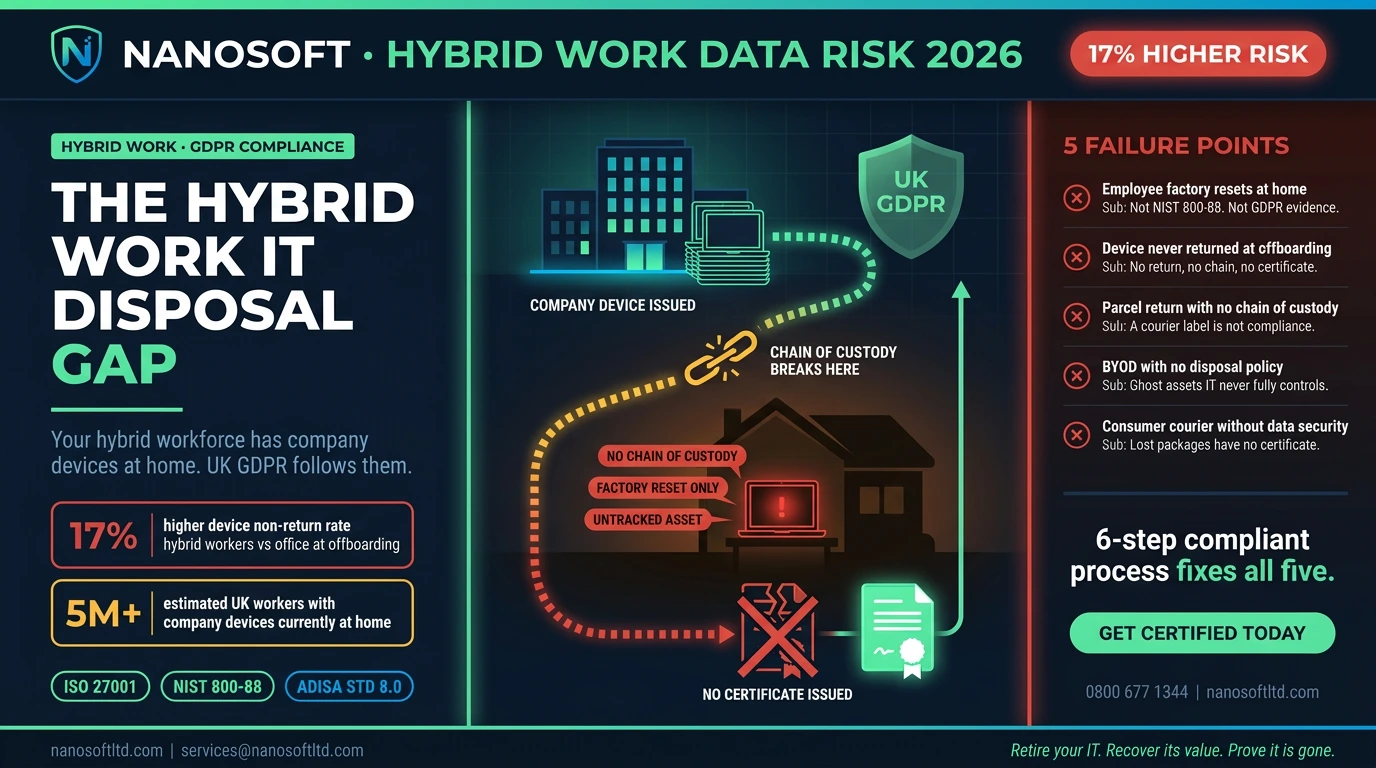
Hybrid and remote workers are 17% more likely than office-based colleagues not to return devices at offboarding.
UK GDPR applies to all company devices regardless of where they were used or where they currently are.
A factory reset carried out by an employee at home has zero evidential value as a GDPR compliance measure.
A parcel label from a home address to your office is not a chain of custody.
The six-step compliant process for remote device disposal is straightforward to implement and creates the audit trail that protects you.
The scale of the problem no one is measuring
Most IT asset registers are built around office-based infrastructure. Servers in racks, desktops on desks, laptops signed out through IT. The pandemic years changed that, and the hybrid settlement that followed has created a class of asset that most organisations manage poorly: the home-based device.
Data shows that hybrid and remote employees are 17% more likely than office-based colleagues not to return devices when offboarding. For a business with 50 remote workers turning over staff at a typical rate, that gap compounds quickly into a meaningful number of unaccounted data-bearing assets. Each one carries the same GDPR obligations as a server in your data centre. Each one requires the same standard of documented destruction.
The problem is compounded by the nature of hybrid offboarding. An office-based leaver returns their equipment to IT on their last day. A remote leaver ships a parcel, puts a device in their car boot, or simply fails to mention it at all. Organisations must ensure that data on remote devices is destroyed in a compliant manner and must be able to demonstrate that they have taken all necessary steps to protect data throughout its lifecycle including its secure destruction, regardless of where the device was used.
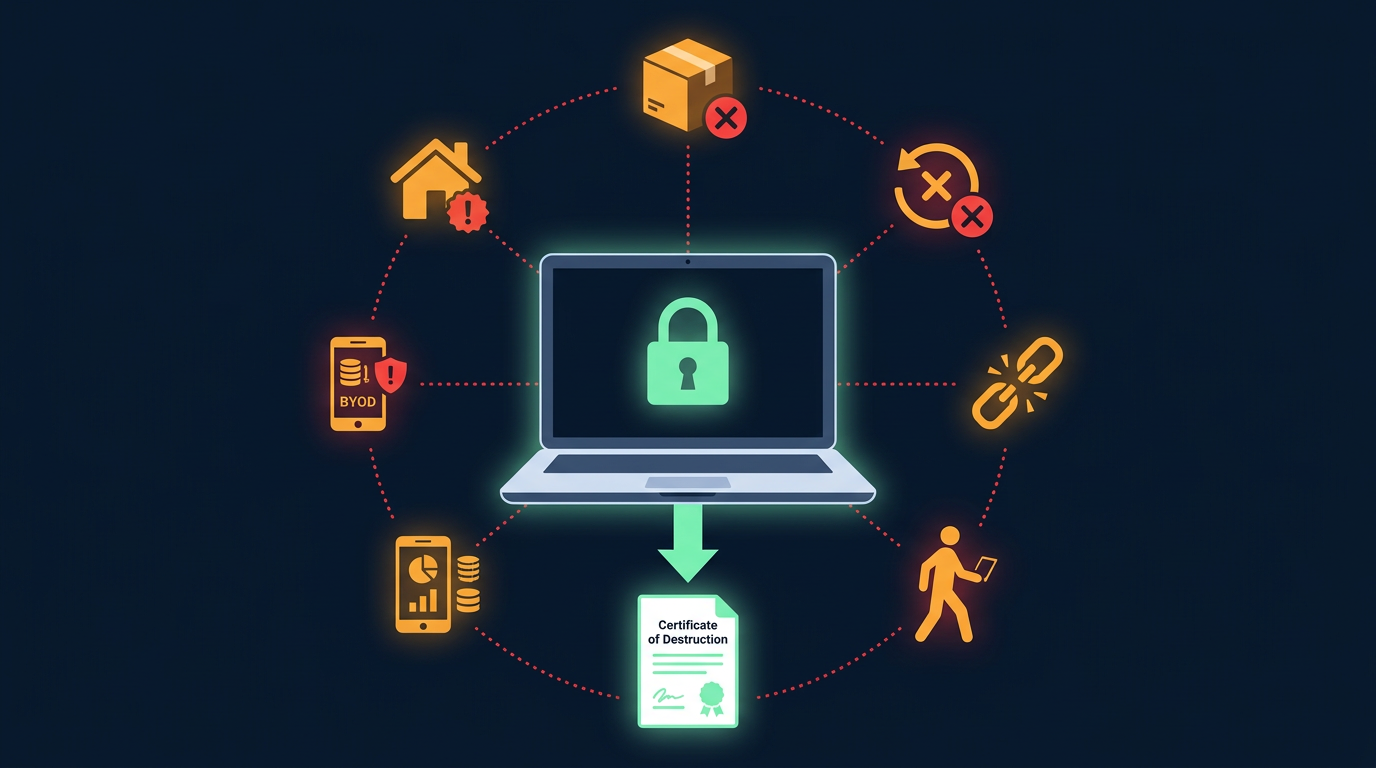
The five points where remote device disposal fails
The failure modes for remote IT disposal are consistent across organisations of all sizes. Recognising them is the first step to closing the gap.
1. The employee factory reset. A departing remote worker, trying to be helpful, factory resets their laptop before posting it back. They tell HR it is wiped. HR tells IT. IT closes the ticket. Factory resets and file deletion are not secure disposal methods, and compliance frameworks like NIST 800-88 and GDPR require verifiable erasure with documented proof. A factory reset deletes the directory. The data remains on the drive and is recoverable with basic forensic tools. There is no certificate, no standard applied, and no audit trail.
2. The unreturned device. Terminated employees present the highest risk. A poorly managed offboarding process may result in a device never being returned at all. Without a return, there is no chain of custody, no destruction, and no certificate. The data simply sits on a device outside your control indefinitely.
3. The uncertified return. A device is returned from a home address, but arrives at the office in a parcel with a courier label. It is received by reception, passed to IT, and eventually disposed of through whatever process IT uses. At no point is the chain of custody formally documented from the employee's home address to the final disposal outcome. Without that chain, the certificate of destruction is incomplete.
4. BYOD with no disposal policy. Bring-your-own-device arrangements create a category of asset that IT never fully controls. Company emails, files, credentials and client data sit on personal devices with no agreed destruction process. When the employee leaves or the device is retired, the data has no formal disposal pathway.
5. Consumer courier for device return. A DPD or Royal Mail label is not a chain of custody document. Packages are lost, damaged and in some cases intercepted. A device that goes missing in transit has no certificate of destruction and remains a live data exposure until it is confirmed destroyed. For a regulated business, that gap is an ICO risk.
The six-step compliant process
Remote device disposal is logistically more complex than office-based disposal. It is not, however, more legally complex. The same standards apply. What changes is the operational process needed to meet them.
Step 1: Update the IT asset register before offboarding begins. Every device must be logged by serial number, location and assigned user before the offboarding process starts. This is the baseline from which the chain of custody flows.
Step 2: Arrange certified collection from the employee's home address. This is the most critical operational step and the one most organisations skip. A specialist certified collection service arrives at the employee's address, formally takes custody of the device with documented paperwork, and transfers that custody to the ITAD facility. This is the point at which the chain of custody begins.
Step 3: Log the device on receipt at the processing facility. Serial number confirmed against the asset register, condition noted, any damage documented. Chain of custody is formally transferred and the device enters the certified destruction workflow.
Step 4: Apply data sanitisation to NIST SP 800-88 Rev. 2 Purge standard. Not factory reset. Not quick format. The certified standard, applied per device, verified and logged per serial number. For SSDs, ATA Secure Erase to reach over-provisioned cells. For damaged or high-sensitivity media, physical destruction.
Step 5: Issue a Certificate of Data Destruction per device. Named by serial number, confirming the method and standard applied, dated, and signed by the certifying party. From Q4 2026, this certificate must also carry a DEFRA Digital Waste Tracking consignment reference.
Step 6: Assess and recover value. Devices in working condition are assessed for refurbishment and responsible resale. The value recovered is returned to the employer. Devices beyond economic repair enter licensed WEEE recycling. Nothing goes to landfill and nothing is exported without documentation.
What your remote IT disposal policy must include
If your organisation does not have a written remote device disposal policy, it is effectively relying on employee goodwill and hoping the ICO does not ask. The policy should cover four things: the scope of devices affected including BYOD; the trigger events for disposal including leavers, upgrades and device retirement; the approved collection and destruction method; and the retention period for certificates and records.
The policy does not need to be long. It needs to exist, be followed and generate evidence that it was followed. That evidence is a Certificate of Data Destruction. Without it, the policy is a statement of intent, not a compliance measure.
Retire your IT. Recover its value. Prove it is gone.
Nanosoft provides certified home collection and IT asset disposal for remote and hybrid workforces across the UK. We collect from employee home addresses with full chain of custody documentation, apply NIST SP 800-88 Rev. 2 certified data destruction, and return a serial-level Certificate of Data Destruction for every device. Where assets hold reusable value, we recover it and return it to you.
Contact Nanosoft: services@nanosoftltd.com | 0800 677 1344 | Unit 8 & 9 Maldon Trade Park, Heybridge, Maldon CM9 4LJ, UK
Nanosoft Team
Writer at Nanosoft - covering ITAD, data security, and sustainable technology lifecycle management.
Found this useful? Share it.