International E-Waste Day falls on 14 October, and this year the WEEE Forum has picked "Fast Tech" as its theme: "low-cost electrical and electronic items that consumers purchase, often on impulse." Earphones, charging cables, USB adapters, LED lights, mini fans. The campaign is aimed at households. Offices have exactly the same problem, and two parts of it carry risks a household's does not.
The scale, from the household side
The best UK numbers come from a 2023 study by Material Focus, the not-for-profit behind the Recycle Your Electricals campaign. It found "over half a billion small 'FastTech' electricals bought in the UK last year", which it put at 16 items every second, and "471 million items binned in the past year."
The breakdown of what was thrown away is the interesting part: 260 million disposable vapes, 29 million LED, solar and decorative lights, 26 million cables, and 9.8 million USB sticks.
Two caveats before borrowing those figures. They come from a survey of 2,000 UK adults, run by Opinium in July 2023, so they describe consumers rather than businesses. And there is no equivalent study of what offices throw away. What follows about workplaces is our observation, not a statistic.
The office version
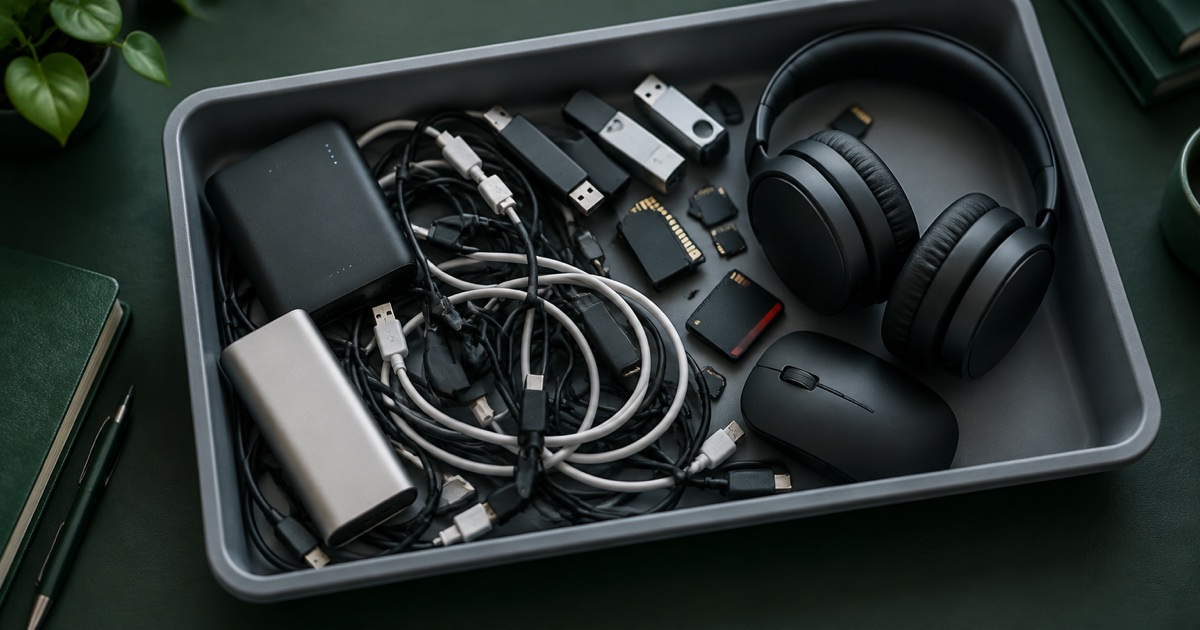
Every organisation that runs an IT estate also runs a second, unrecorded one. Headsets, chargers, cables, adapters, docks, mice, keyboards, power banks, USB sticks and memory cards. They are cheap, they arrive with new kit or get bought on expenses, and they are almost never on the asset register.
Which means they are also almost never on the disposal plan. Laptops and servers go through a documented process. The accessories end up in a drawer, a cupboard or the general waste bin when someone finally clears the drawer.
Most of that is a recycling problem rather than a risk. Two categories are different.
| Item | Holds data? | Main risk | Sensible route |
|---|---|---|---|
| USB sticks and memory cards | Yes | Data left on cheap flash storage nobody tracked | Treat as storage media: sanitise or destroy, with a record |
| Power banks and battery-powered accessories | No | Battery fires in waste vehicles and sites | Separate collection, batteries described on the paperwork |
| Cables, chargers and adapters | No | Lost materials, mainly copper | WEEE recycling through an authorised route |
| Headsets, mice, keyboards and docks | Not usually | Batteries in wireless models | WEEE recycling, batteries handled as above |
The USB stick problem
A USB stick is storage. It is usually the cheapest storage an organisation owns, which is exactly why nobody treats it like storage.
It also does not respond well to the usual quick fix. Most USB sticks and memory cards are flash memory, and NIST's guidance on media sanitisation is explicit that overwriting cannot reliably clean flash. Devices "that contain spare cells and perform wear levelling make it infeasible for a user to sanitize all previous data using this approach." Formatting a stick before binning it, or even writing over it, does not reach everything.
So the right treatment is the same as for any other drive: sanitise it properly or destroy it, and record that you did. The point of International E-Waste Day for an IT team is less about the cables and more about the box of unlabelled memory sticks that has been sitting in a cupboard since the last office move.
The battery problem
The WEEE Forum's own figures make the case for the theme. "36% of e-waste operators reported a battery-related fire at their facilities in the past year." Power banks, wireless headsets, wireless mice and other battery-powered accessories that go out in general waste end up in vehicles and sites that are not set up for them.
There is a classification detail worth knowing here. GOV.UK's guidance on classifying waste electrical equipment lists lithium and lithium-ion batteries as "Non-hazardous", under waste code 16 06 05. Nickel-cadmium batteries, by contrast, are hazardous. Our reading: a non-hazardous code is a statement about chemical classification, not about fire risk. A lithium battery that is non-hazardous on paper can still start a fire in a refuse lorry.
What the rules actually ask of a business
It is easy to overstate this, so precisely: there is no single UK rule that says "never put small electricals in the bin". The obligations come from more general law.
It is waste once you discard it. GOV.UK puts it simply: "any EEE which the holder discards, intends to discard, or is required to discard, is 'waste'." A drawer of old chargers being cleared out is waste electrical and electronic equipment.
The duty of care applies. The statutory code of practice says waste should be described so that later handlers can deal with it properly, including whether it "needs particular treatment or handling, for example batteries or waste electrical and electronic equipment (WEEE)." It is also blunt about the consequence: "Failure to comply with the duty of care requirements is a criminal offence and could lead to prosecution."
It needs paperwork when it moves. Transporting WEEE requires a waste transfer note or equivalent for non-hazardous waste, and a consignment note for hazardous waste.
Your supplier may already be paying for it. For business equipment placed on the market on or after 13 August 2005, producer compliance schemes take on the financial obligations for its treatment "unless alternative arrangements have been made between the producer and the business end-user." It is worth checking what your purchase terms say before paying to dispose of something a producer is already financing.
A sensible plan for 14 October
None of this needs a project. It needs an hour and a box.
Collect the drawers. Gather the accessories and loose media from desks, cupboards and meeting rooms into one place.
Pull out the storage. USB sticks, memory cards and any loose drives go to the same process as your other data-bearing assets, with a record against them.
Separate the batteries. Power banks and battery-powered accessories go in their own container, described as such on the paperwork.
Send the rest for recycling through an authorised route, and keep the transfer note.
The honest summary
International E-Waste Day is pitched at households, and the fast tech numbers describe consumers. But every office has its own fast tech, and almost none of it is tracked. Most of it is a recycling issue. The USB sticks are a data issue and the power banks are a fire issue, and both are cheap enough that nobody thinks about them until something goes wrong.
The fix is to stop treating them as too small to matter. Count the storage, separate the batteries, and give the rest a proper route out of the building.
Nanosoft Team
Writer at Nanosoft - covering ITAD, data security, and sustainable technology lifecycle management.
Found this useful? Share it.