Cybersecurity Overtakes AI as the Top UK Tech Investment for 2026: What That Means for Your IT Refresh Cycle
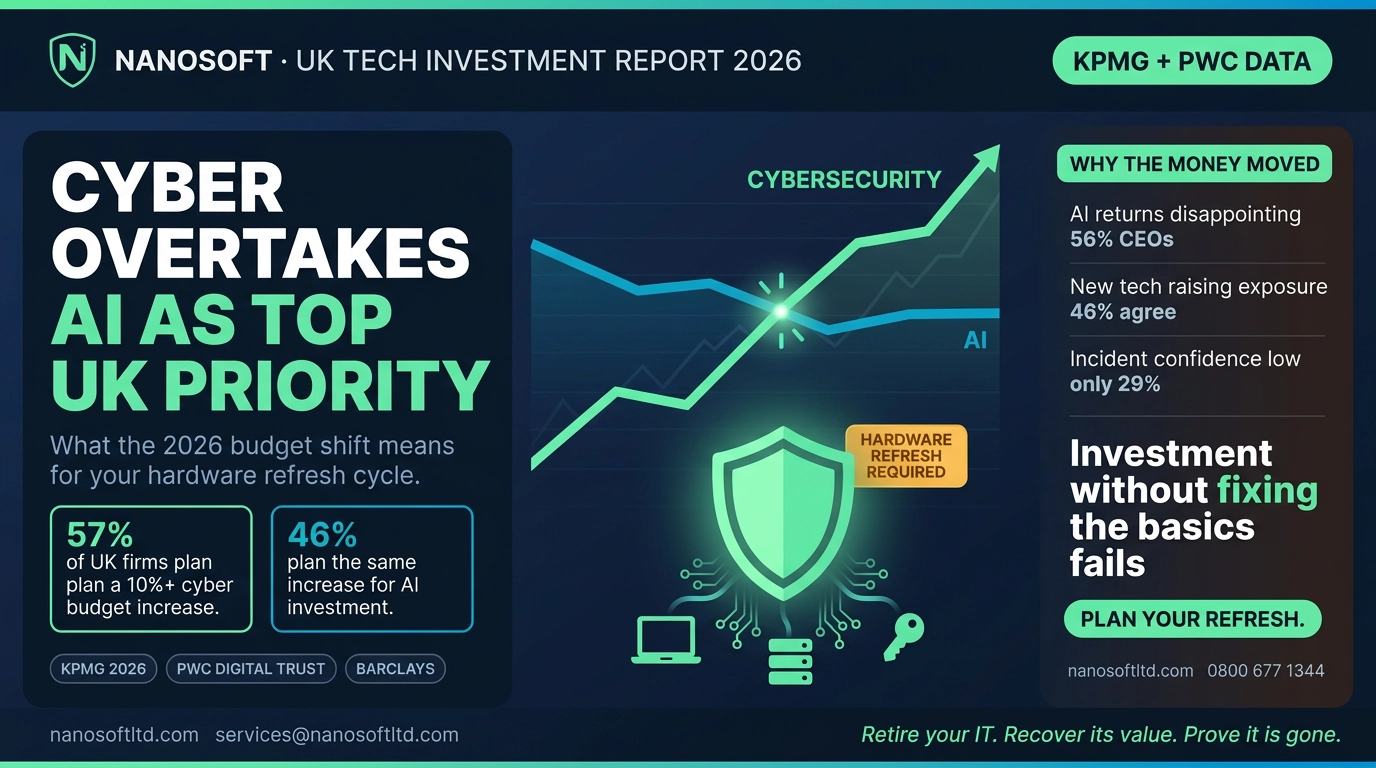
After three years of AI dominating every boardroom agenda, 2026 marks a genuine reversal. More than half of UK organisations report they are planning on increasing their budget for cybersecurity by more than 10% over the next 12 months, comfortably ahead of the 46% planning the same increase for AI. This is not a small shift. It is the clearest signal yet that UK businesses have decided where their next pound of technology spend is actually going.
The reasons behind the shift are as interesting as the shift itself, and they carry a direct, practical consequence that most finance and IT teams have not yet connected: a genuine cyber investment cycle is rarely software alone. It usually means new hardware, which usually means old hardware retiring faster than the depreciation schedule assumed.
Key takeaways
57% of UK companies plan to increase cybersecurity budgets by more than 10% in 2026, versus 46% for AI and a global average of just 41% for cyber.
85% of UK businesses expect their overall cyber budget to increase this year.
Only 29% of UK business leaders feel confident in their organisation's ability to respond to a major cyber incident, despite the spending increase.
46% of UK leaders believe adopting new technology is increasing, not reducing, their cyber exposure.
Modern security tooling frequently requires hardware refresh, creating a wave of IT assets reaching end of life faster than planned depreciation cycles anticipated.
Why the money moved
Three factors explain why UK cyber spend has pulled ahead of AI spend for the first time.
AI has not delivered the returns that were promised. A PwC analysis found that 56% of CEOs now believe they have seen no benefit from funnelling funds into the technology, and a separate MIT study found fewer than one in ten firms investing in AI had enjoyed a return on investment. After three years of hype, boards are recalibrating where genuine value sits, and for many, that answer is resilience rather than automation.
New technology is expanding risk faster than it is reducing it. Almost half of UK business leaders, 46%, believe the adoption of new technologies is increasing their exposure to cybersecurity risk, according to Barclays' Q1 2026 Business Prosperity Index. Every new tool, integration and AI agent introduced into an organisation's technology stack is a new attack surface. When AI agents can trigger workflows, access data and interact with customers, organisations need identity and access controls, audit trails and human oversight, which itself represents new investment, and often new infrastructure to support it.
Confidence has not kept pace with spending. Despite 68% of UK business leaders expecting to increase cybersecurity investment over the next 12 months, fewer than three in ten, 29%, are confident in their organisation's ability to respond to a major cyber incident. Money is moving toward the problem faster than certainty about the solution.
The scale of the shift
The UK is not just following a global trend. It is leading it. The global average for organisations planning a 10% or greater increase in cybersecurity spend is 41%. The UK figure is 57%, sixteen points ahead. Paul Henninger, Head of Technology and Data at KPMG UK, put it plainly: UK organisations are putting real money behind cyber resilience, with more than half planning double-digit increases, and the message is not to buy cyber tools for the sake of it but to start with your most critical assets, fix the basics, and assign clear accountability.
That last phrase, fix the basics, deserves attention. It is a direct echo of the finding from the government's own Cyber Security Breaches Survey: businesses know the risk but have not translated that awareness into foundational controls. Investment alone does not close that gap. Investment spent on the right foundations does.
What a cyber investment cycle actually means for your hardware
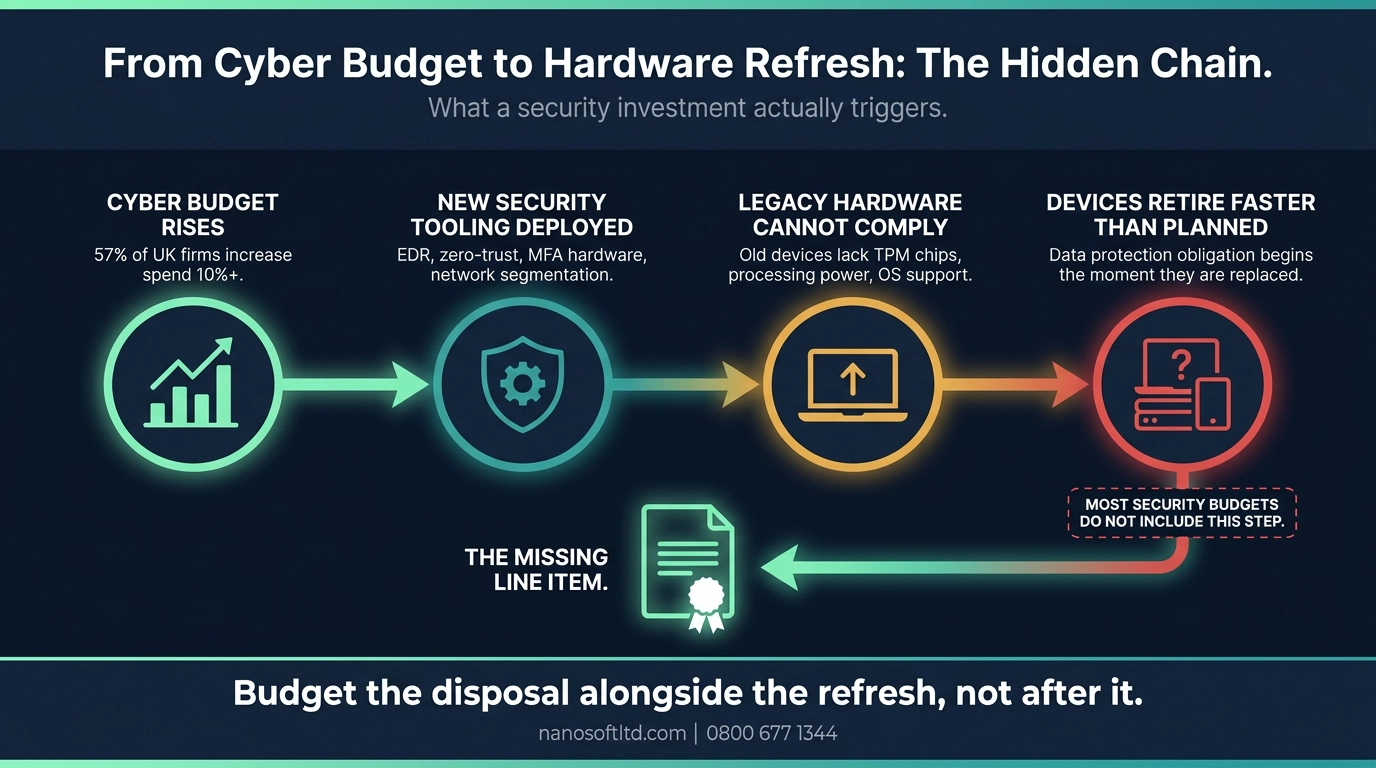
Here is the connection that gets missed in most commentary on this trend. A genuine cybersecurity investment programme is rarely a pure software purchase layered onto existing infrastructure unchanged. It typically involves some combination of the following, and every one of them has a hardware refresh implication.
Endpoint detection and response (EDR) platforms require processing capacity and modern operating system support that ageing laptops and desktops frequently cannot provide efficiently. Organisations rolling out EDR at scale often discover a meaningful proportion of their device fleet needs replacing to run the agent without degrading performance.
Zero-trust architecture depends on hardware-backed security features: TPM chips, modern biometric authentication, hardware security keys. Devices manufactured before these became standard cannot participate fully in a zero-trust rollout, creating pressure to refresh the fleet alongside the software rollout.
Multi-factor authentication hardware, including physical security keys and biometric readers, is being deployed more widely as password-only access is phased out. This is new hardware entering the estate, which means old authentication infrastructure retiring.
Network segmentation and modern firewalls frequently require replacing legacy network hardware that cannot support the granular policy control modern security architectures demand.
Every one of these upgrade paths produces the same downstream event: a batch of retired devices that held organisational data, now needing certified, documented disposal. A 2026 cyber investment surge is, in practical terms, an IT asset disposal event waiting to happen for most organisations, whether their finance team has budgeted for it or not.
The compliance layer nobody budgets for
This is the detail most finance teams miss when approving a cybersecurity investment programme. The budget covers the new software licences, the new hardware purchase, the implementation consultancy and the staff training. It rarely includes a specific line for certified destruction of the hardware being replaced.
Under UK GDPR, every device retired during a security upgrade still carries whatever data it held. Replacing an ageing laptop fleet to support modern EDR does not reduce your data protection obligation for those retired laptops. It creates a new one. If the retired devices are handed to whichever recycling company happens to be cheapest, or worse, resold without certified sanitisation, the security investment your organisation just made is undermined by the disposal process that followed it.
What finance and IT teams should build into the next cyber investment cycle
Three practical adjustments prevent the disposal gap from becoming a liability.
Budget for certified disposal alongside the refresh, not after it. When scoping a hardware refresh tied to a security programme, include ITAD costs in the same budget line as the new equipment. Value recovery on the retiring devices can offset a meaningful proportion of this cost.
Time the disposal to the rollout, not to whenever IT gets around to it. Devices awaiting disposal after a refresh are a live data protection risk sitting in a cupboard. The faster they move through certified destruction, the shorter the exposure window.
Treat the Certificate of Destruction as part of the security programme's documentation, not a separate afterthought. When your board reviews the outcomes of a cyber investment programme, the disposal certificates for the replaced hardware are as relevant as the new tooling's deployment report. Both demonstrate the same thing: appropriate technical measures, properly evidenced.
Retire your IT. Recover its value. Prove it is gone.
Nanosoft supports UK organisations running hardware refresh programmes as part of wider cybersecurity investment, providing certified data destruction to NIST SP 800-88 Rev. 2, serial-level Certificates of Destruction, and value recovery on reusable devices that helps offset the cost of the refresh itself.
Contact Nanosoft: services@nanosoftltd.com | 0800 677 1344 | Unit 8 & 9 Maldon Trade Park, Heybridge, Maldon CM9 4LJ, UK
Nanosoft Team
Writer at Nanosoft - covering ITAD, data security, and sustainable technology lifecycle management.
Found this useful? Share it.